
data analysis // revision
Our testing methods went through sensor accuracy, prediction accuracy, simulated testing, and on site testing. So, we analyzed the data that we gathered and used this for corrections and then to compare against SRR and analyze. The first phase of our testing included comparing the sensor readings coming from AvAlert and putting them up against measured values. From this, we could account for the difference by code correcting it to make sure the numbers AvAlert was analyzing were as close to real values as possible. First, we tested depth by digging real snowpits to compare the depth that AvAlert is reading with the actual pit depth. We performed on-site calibration in order to get reliable values for depth readings, testing at a baseline of 3ft. Within 6 recalibration attempts, we got it so close that our sonar reading was only 0.02 ft away, or 0.6% different than actualized values. We also found similar success with the accuracy of the other sensors. Temperature was off at most by 0.1 degrees, with an average difference of less than 0.25%. Angle was off by at most 1 degree, which was later code corrected down close to zero. In addition, altitude was off by around 40 feet, which at an altitude around 10-11,000 feet is only around 0.36% off.
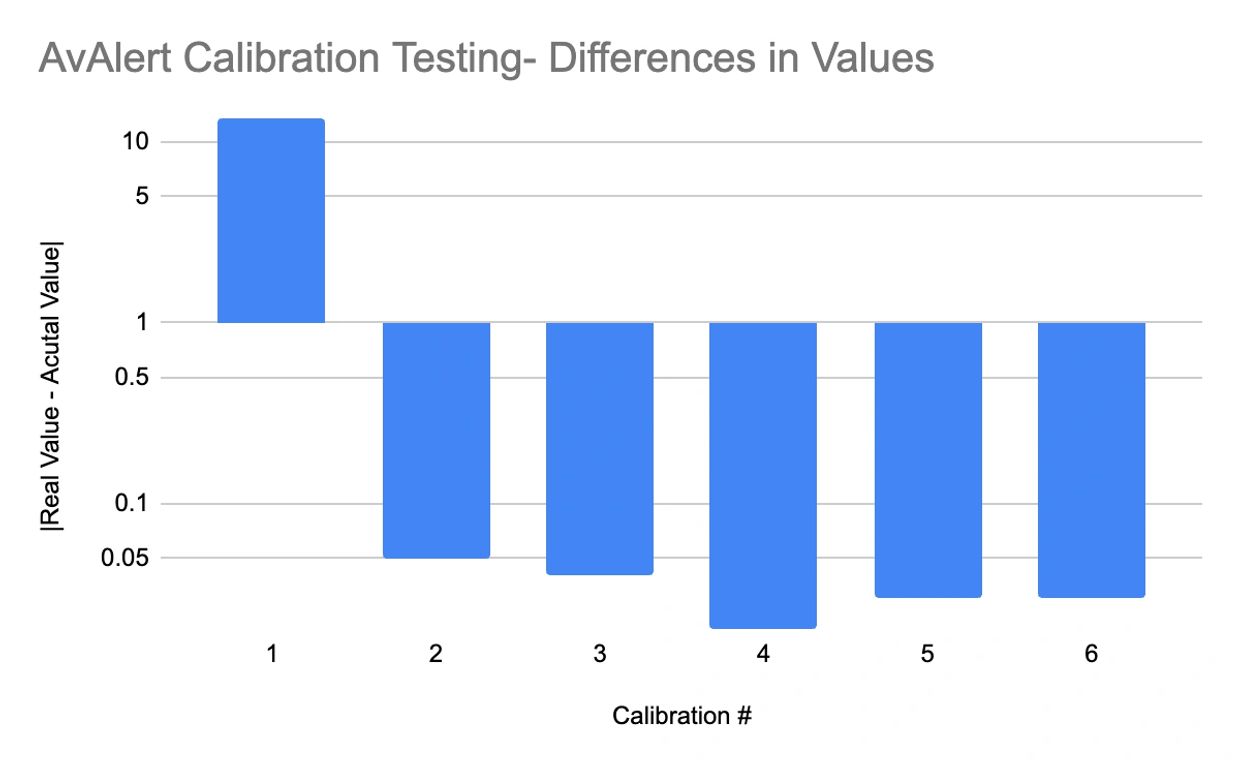
AvAlet Depth Sensing Calibration - Difference Between Measured and AvAlert Values

In addition, the code was predicting accordingly to the mathematical analysis and equation parameters we created.
On top of quantitative measures, we also saw lots of promising trends in the field. From our expertise, when skiing on more powedery fields with less risk and low slab probability, AvAlert predicted stable accordingly. In addition, when we trekked with AvAlert on steeper and more dangerous slopes, AvAlert also responded accordingly.
We were also able to utilize AvAlert when it was stored inside of a backpack, as the sonar capabilities passed through the fabric in the backpack. Usability seemed highly viable for a skiier and rider market, and the data was easily usable in the field.
Overall, we are super happy with how AvAlert performed in the field, and it seems to uphold and adhere to our standards and industry conditions.